About Mount Kilimanjaro - Africa Natural Tours ( africanaturaltours.com )
About
Mount Kilimanjaro: Africa Natural Tours (For
Kilimanjaro, Serengeti and Zanzibar) the best tour company in Tanzania
Specialized
in: Wildlife safaris, Mountain climbing, Cultural tourism, and Beach holidays
in East Africa
Contact
+255 764415889
Email: info@africanaturaltours.com Website:
www.africanaturaltours.com

About Mount Kilimanjaro
Mount Kilimanjaro is a dormant volcano
in Tanzania.
It is the highest mountain
in Africa,
and rises approximately 4,900 m (16,000 ft) from its base to 5,895 metres
(19,341 ft) above sea level. The first recorded ascent to the summit of
the mountain was by Hans Meyer and Ludwig Purtscheller in 1889. The mountain
is part of the Kilimanjaro National Park and is a major climbing destination.
The mountain has been the subject of many scientific studies because of its
shrinking glaciers. Kilimanjaro
rises approximately 4,900 m (16,000 ft) from its southern base in the
plains near the municipality of Moshi to its summit height of 5,895 metres (19,341 ft).
Kilimanjaro is the highest volcano outside South America.
Mt Kilimanjaro the famed ice capped mountain lies just 3° south of
the equator. As Tanzania's landmark, Kilimanjaro towers over the surrounding
African plains. In fact, it is the highest freestanding mountain in the world
(5,895 meters/ 19,341 ft). It is also the highest mountain that can be climbed
without technical equipment and climbing skills. For the most part, it takes
just putting one foot in front of the other. Although this sounds simple, it is
most likely the toughest challenge you will ever face. Our success rate places
us among the industry leaders and we guarantee that we will not compromise your
safety; using only quality equipment and only the best experienced guides and
cooks. Our guides are trained to monitor your physical condition and know how
to pace the group accordingly; offering you the greatest chance of a successful
summit. A Mt. Kilimanjaro climb is unique in that within the span of a few
days, you pass through a wide variety of climates and vegetation zones; from
tropical rain forest to near arctic conditions. The mountain is regulated by
Kilimanjaro National Park which has strict rules concerning routes allowed and
climber’s safety. Of the route choices, the Marangu Route has sleeping huts for
overnights. The huts are basic but have solar lighting. On the other routes,
tents are used for overnights. Because of altitude acclimatization being a big
challenge, adding an extra day to the climbing itinerary can improve the chance
of success substantially. Let Africa Natural Tours help you choose the route
and itinerary that is right for you. Kilimanjaro is composed of three distinct
volcanic cones: Kibo, the highest; Mawenzi at 5,149 metres (16,893 ft) and
Shira, the shortest at 4,005 metres (13,140 ft). Mawenzi and Shira are extinct,
while Kibo is dormant and could erupt again. Uhuru Peak is the highest summit on Kibo's
crater rim. The height is based on a British
Ordnance Survey in 1952. Since then, the height has been measured as
5,892 metres (19,331 ft) in 1999, 5,891 metres (19,327 ft) in 2008,
and 5,888 metres (19,318 ft) in 2014. Kilimanjaro has 2.2 square kilometers of
glacial ice and is losing it quickly due to global
warming. The glaciers have shrunk 82% since 1912 and declined 33%
since 1989. It may be ice free within 20 years, dramatically affecting local
drinking water, crop irrigation, and hydroelectric power. The interior of the
volcanic edifice is poorly known, given the lack of large scale erosion that
could have exposed the interiors of the volcano. Eruptive activity at the Shira
centre commenced about 2.5 million years ago, with the last important phase
occurring about 1.9 million years ago, just before the northern part of the
edifice collapsed. Shira is topped by a broad plateau
at 3,800 metres (12,500 ft), which may be a filled caldera.
The remnant caldera rim has been degraded deeply by erosion. Before the caldera
formed and erosion began, Shira might have been between 4,900 m
(16,000 ft) and 5,200 m (17,000 ft) high. It is mostly composed of
basic lavas with some pyroclastics. The formation of the caldera was
accompanied by lava emanating from ring fractures, but there was no large scale explosive activity. Two cones formed subsequently,
the phonolitic
one at the northwest end of the ridge and the doleritic
"Platzkegel" in the caldera centre. Both Mawenzi and Kibo began
erupting about 1 million years ago. They are separated by the "Saddle
Plateau" at 4,400 metres (14,400 ft) elevation. The youngest dated
rocks at Mawenzi are about 448,000 years old. Mawenzi forms a horseshoe shaped
ridge with pinnacles and ridges opening to the northeast which has a tower like
shape resulting from deep erosion and a mafic dyke swarm.
Several large cirques
cut into the ring, the largest of these sits on top of the Great Barranco
gorge. Also notable are the Ost and West Barrancos on the northeastern side of
the mountain. Most of the eastern side of the mountain has been removed by
erosion. Mawenzi has a subsidiary peak named Neumann Tower (4,425
metres (14,518 ft)). Kibo is the
largest cone and is more than 15 miles (24 km) wide at the "Saddle
Plateau" altitude. The last activity here has been dated to between
150,000 and 200,000 years ago and created the current Kibo summit crater. Kibo
still has gas-emitting fumaroles in the crater. Kibo is capped by an almost
symmetrical cone with escarpments rising 180 metres (590 ft) to 200 metres
(660 ft) on the south side. These escarpments define a 2.5-kilometre-wide
(1.6 mi) caldera[15]
caused by the collapse of the summit. Within this caldera is the Inner Cone and
within the crater of the Inner Cone is the Reusch Crater, which the Tanganyika
government in 1954 named after Gustav Otto
Richard Reusch upon his climbing the mountain for the 25th
time (out of 65 attempts during his lifetime). The Ash Pit, 350 metres
(1,150 ft) deep, lies within the Reusch Crater. About 100,000 years ago,
part of Kibo's crater rim collapsed, creating the area known as the Western
Breach and the Great Barranco. An almost continuous layer of lavas buries older
geological features, with the exception of exposed strata
within the Great West Notch and the Kibo Barranco. Kibo has five main lava
formations: Phonotephrites and tephriphonolites
of the "Lava Tower group", on a dyke
cropping out at 4,600 metres (15,100 ft), 482,000 years ago,
Tephriphonolite to phonolite lavas "characterized by rhomb
mega-phenocrysts of sodic feldspars" of the "Rhomb Porphyry
group", 460,000–360,000 years ago, aphyric
phonolite lavas, "commonly underlain by basal obsidian horizons", of
the "Lent group", 359,000–337,000 years ago, porphyritic tephriphonolite to phonolite lavas
of the "Caldera rim group", 274,000–170,000 years ago and phonolite
lava flows with aegirine phenocrysts, of the "Inner Crater group", which
represents the last volcanic activity on Kibo. Kibo has more than 250 parasitic
cones on its northwest and southeast flanks that were formed between
150,000 and 200,000 years ago and erupted picrobasalts,
trachybasalts,
ankaramites,
and basanites.
They reach as far as Lake Chala and Taveta in the southeast and the Lengurumani
Plain in the northwest. Most of these cones are well preserved, with the
exception of the Saddle Plateau cones that were heavily affected by glacial
action. Despite their mostly small size, lava from the cones has obscured large
portions of the mountain. The Saddle Plateau cones are mostly cinder cones with
terminal effusion of lava, while the Upper Rombo Zone cones mostly generated
lava flows. All Saddle Plateau cones predate the last glaciation.
The history of the geology of Mount
Kilimanjaro
Word Kilimanjaro, The origin of the name
"Kilimanjaro" is not precisely known, but a number of theories exist.
European explorers had adopted the name by 1860 and reported that
"Kilimanjaro" was the mountain's Kiswahili name. The 1907 edition of The Nuttall Encyclopædia
also records the name of the mountain as "Kilima-Njaro".Johann Ludwig Krapf wrote in 1860 that Swahilis along
the coast called the mountain "Kilimanjaro". Although he did not
support his claim, he claimed that "Kilimanjaro" meant either
"mountain of greatness" or "mountain of caravans". Under
the latter meaning, "Kilima" meant "mountain" and
"Jaro" possibly meant "caravans".Jim Thompson claimed in
1885, although he also did not support his claim, that the term Kilima-Njaro
"has generally been understood to mean" the Mountain (Kilima) of
Greatness (Njaro). "Though not improbably it may mean" the
"White" mountain. "Njaro" is an ancient Kiswahili word for
"shining". Similarly, Krapf wrote that a chief of the Wakamba people, whom he visited in 1849, "had been to Jagga and had
seen the Kima jaJeu, mountain of whiteness, the name given by the Wakamba to
Kilimanjaro...." More correctly in the Kikamba language, this would be Kiima Kyeu, and this possible derivation has
been popular with several investigators. Others have assumed that
"Kilima" is Kiswahili for "mountain". The problem with this
assumption is that "Kilima" actually means "hill" and is,
therefore, the diminutive of "Mlima", the proper
Kiswahili word for mountain. A different approach is to assume that the
"Kileman" part of Kilimanjaro comes from the Kichagga
"kileme", which means "which defeats", or "kilelema",
which means "which has become difficult or impossible". The
"Jaro" part would "then be derived from njaare, a bird, or,
according to other informants, a leopard, or, possibly from jyaro a
caravan." Considering that the name Kilimanjaro has never been current
among the Wachagga people, it is possible that the name was
derived from Wachagga saying that the mountain was unclimbable,
"kilemanjaare" or "kilemajyaro" and porters misinterpreted
this as being the name of the mountain. In the 1880s, the mountain became a
part of German East Africa and was called
"Kilima-Ndscharo" in German following the Kiswahili name components.
On 6 October 1889, Hans Meyer reached the highest summit on the
crater ridge of Kibo. He named it "Kaiser-Wilhelm-Spitze" ("Kaiser Wilhelm peak").
That name apparently was used until
Tanzania was formed in 1964, when the summit was renamed "Uhuru
Peak", meaning "Freedom Peak" in Kiswahili.
Climbing history of Mount
Kilimanjaro
In August 1861, the Prussian officer
Baron Karl Klaus von der
Decken
accompanied by English geologist R. Thornton made a first attempt to climb Kibo
but "got no farther than 8,200 feet (2,500 m) owing to the inclemency
of the weather. In December 1862, von der Decken tried a second time together
with Otto Kersten. They reached a height of 14,000
feet (4,300 m). In August 1871, missionary Charles
New became the "first European to
reach the equatorial snows" on Kilimanjaro at an elevation of slightly
more than 13,000 feet (4,000 m).
In
June 1887, the Hungarian Count Sámuel Teleki and Austrian Lieutenant Ludwig von Höhnel made an attempt to climb the
mountain. Approaching from the saddle between Mawenzi and Kibo, Höhnel stopped
at 4,950 meters (16,240 ft), but Teleki pushed through until he reached
the snow at 5,300 meters (17,400 ft). Later in 1887 during his first
attempt to climb Kilimanjaro, the German geology professor Hans Meyer reached
the lower edge of the ice cap on Kibo, where he was forced to turn back because
he lacked the equipment needed to handle the ice. The following year, Meyer
planned another attempt with Oscar Baumann, a cartographer, but the mission was aborted after the pair were held
hostage and ransomed during the Abushiri Revolt. In the autumn of 1888, the American naturalist Dr. Abbott
and the German explorer Otto Ehrenfried
Ehlers
approached the summit from the northwest. While Abbott turned back earlier,
Ehlers at first claimed to have reached the summit rim but, after severe
criticism of that claim, later withdrew it.In 1889, Meyer returned to
Kilimanjaro with the Austrian mountaineer Ludwig Purtscheller for a third attempt. The success of
this attempt was based on the establishment of several campsites with food
supplies so that multiple attempts at the top could be made without having to
descend too far. Meyer and Purtscheller pushed to near the crater rim on
October 3 but turned around exhausted from hacking footsteps in the icy slope.
Three days later, on Purtscheller's fortieth birthday, they reached the highest
summit on the southern rim of the crater. They were the first to confirm that
Kibo has a crater. After descending to the saddle between Kibo and Mawenzi,
Meyer and Purtscheller attempted to climb the more technically challenging
Mawenzi but could reach only the top of Klute Peak, a subsidiary peak, before
retreating due to illness.[39]:84
On October 18, they reascended Kibo to enter and study the crater, cresting the
rim at Hans Meyers Notch. In total, Meyer and Purtscheller spent 16 days above
15,000 feet (4,600 m) during their expedition. They were accompanied in
their high camps by Mwini Amani of Pangani, who cooked and supplied the sites with water and firewood.
The first ascent of the highest summit of Mawenzi was made on 29 July 1912, by
the German climbers Edward
Oehler and Fritz
Klute, who
christened it Hans Meyer Peak. Oehler and Klute went on to make the third-ever
ascent of Kibo, via the Drygalski Glacier, and descended via the Western
Breach. In 1989, the organizing committee of the 100-year celebration of the
first ascent decided to award posthumous certificates to the African
porter-guides who had accompanied Meyer and Purtscheller. One person in pictures or documents
of the 1889 expedition was thought to match a living inhabitant of Marangu, Yohani Kinyala Lauwo. Lauwo did not know his own age Nor
did he remember Meyer or Purtscheller, but he remembered joining a Kilimanjaro
expedition involving a Dutch doctor who lived near the mountain and that he did
not get to wear shoes during the climb.
Lauwo claimed that he had climbed the mountain three times before the
beginning of World War I.
The committee concluded that he had been a member of Meyer's team and
therefore must have been born around 1871. Lauwo died on 10 May 1996, 107 years
after the first ascent, but now is sometimes even suggested as
co-first-ascendant of Kilimanjaro.
Fastest male ascent and descent
The
fastest ascent-descent has been recorded by the Swiss-Ecuadorian mountain guide
Karl
Egloff (born 16
March 1981 in Quito), who ran to the top and back in 6 hours and 42 minutes on
13 August 2014. Previous records were held by Spanish mountain runner Kílian Jornet (7 hours, 14 minutes on 29
September 2010) and by Tanzanian guide Simon Mtuy (9 hours, 21 minutes on 22
February 2006).
Fastest female ascent and descent
The
female ascent record is held by Anne-Marie
Flammersfeld.
On 27 July 2015, she climbed to the summit in 8 hours, 32 minutes via the Umbwe
Route, which is about 30 kilometres (19 mi) long. Born in Germany but
living in Switzerland, she broke the record of Britain's Becky
Shuttleworth
who climbed to the summit in 11 hours, 34 minutes on 20 September 2014.
Flammersfeld then needed 4 hours, 26 minutes to run down to the Mweka Gate, for
a combined asent and descent time of 12 hours, 58 minutes. That broke the
previous record of 18 hours, 31 minutes held by Debbie
Bachman.
Youngest and oldest people to summit
Despite
an age-limit of 10 years for a climbing permit, exceptions are occasionally
granted, and Keats Boyd of Los Angeles was only seven years old when he
summited Kilimanjaro on 21 January 2008. The oldest person to reach Uhuru Peak
was Angela Vorobeva at age 86 years and 267 days. The oldest man to summit the
mountain is American Robert Wheeler, who was 85 years and 201 days when he
summited on 2 October 2014.
Ascents by people with disabilities
Wheelchair-bound
Bernard Goosen scaled Kilimanjaro in six days in 2007, while in 2012 Kyle Maynard, who has no forearms or lower legs, crawled unassisted to
the summit of Mount Kilimanjaro.
First Descent by Snowboard
The
first descent by snowboard was accomplished by Ace Bailey on July1st, 1988.
This descent, at the time, was also the highest altitude descent by snowboard
ever accomplished. This record was held until July the following year. The ride
was photographed by Barry Lewis.
Incredible Handicapped Climber Ascents
The allure of Kilimanjaro has led
other incredible ascents. In 2011, paraplegic
Chris Waddell used a hand-cycle to trek to the summit. Paralysed from the waist
down, Waddell took six and half days and 528,000 revolutions of his
custom-built wheels to reach the Roof of Africa. This amazing achievement was
followed in 2012 by quadruple amputee Kyle Maynard, who took 10 days to crawl
on the stumps of his arms and legs to the top
Trekking Kilimanjaro
There are a couple of things
most travelers will already know about Mt Kilimanjaro: the fact that it is
situated in the northern portion of Tanzania, within the Kilimanjaro National
Park; The fact that it is Africa’s highest mountain. Most adventurers will also
know that Mount Kilimanjaro is made up of three volcanic cones (Kibo, Mawenzi,
and Shira) and is itself a dormant volcanic mountain. However, this certainly
doesn’t mean you know ‘pretty much all there is to know’ about the spectacle
that is Mount Kilimanjaro. Hans Meyer (a German geologist), Ludwig
Purtscheller, and a local named Lauwo were the first people ever to have
reached the summit of Mt Kilimanjaro in October of 1889. (It is possible that
the mountain had already been conquered earlier by locals, but was never
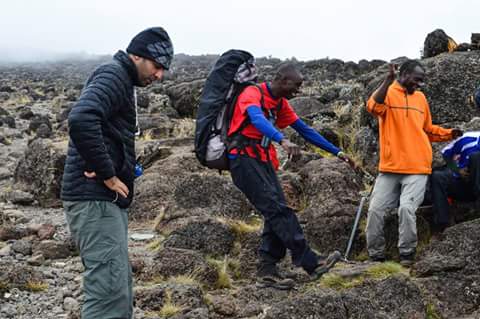
documented). There are seven official routes on Mount Kilimanjaro, six of which
are used for ascent (Machame, Umbwe, Marangu, Shira, Lemosho, Rongai), and one
of which is used for descent only (Mweka).Climbing Kilimanjaro requires no
technical climbing or mountaineering experience. It is just a long trek from
base to summit. Some parts of the mountain require basic
scrambling skills (i.e. the Barranco Wall) but in general, anyone
with decent fitness can climb Kilimanjaro. The challenge is the mountain’s high
elevation. As high mountains go, the routes on Mount Kilimanjaro have rapid
ascent profiles. Acclimatization opportunities are relatively poor and
therefore the incidence of acute
mountain sickness (AMS) is rather high. Some studies show that up to
75% of trekkers on summit night suffer from mild and moderate forms of AMS.
Deaths on Kilimanjaro are often due to improper acclimatization and the onset
of severe altitude
sickness rather than falls.Kilimanjaro is not a peak you can climb
on your own. It is mandatory to climb with a licensed guide and have porters
carry your equipment. This sustains the local economy and allows local people
to reap the rewards of tourism.
Standard client to mountain crew ratio is 1:3
Climbers
should know the number of crew members that will be assisting them from
information obtained during the pre-climb briefing. This way the amount of tips
can be prepared beforehand. We encourage you to meet your crew at your 1st
campsite to make sure you have the number that was promised. You can write a
list with your crew members’ names and refer to this list at the end of the
climb when you give their tips. Tips should be provided to crew members at
the end of the trek at the Africa Natural Tours office in Moshi town and not on
the mountain. Tips can be placed in individual envelopes and the climbers hand
them directly to each crew member. We highly recommend tipping each crew member
directly to ensure full transparency is observed. Kindly note the above
figures are merely recommended amounts that will help give you an indication of
the amount and breakdown of tips provided to the mountain crews. Ultimately the
amount of tips provided to the mountain crews will depend on your budget and
level of satisfaction with our crew’s service.

For more information visit www.africanaturaltours.com

Comments
Post a Comment